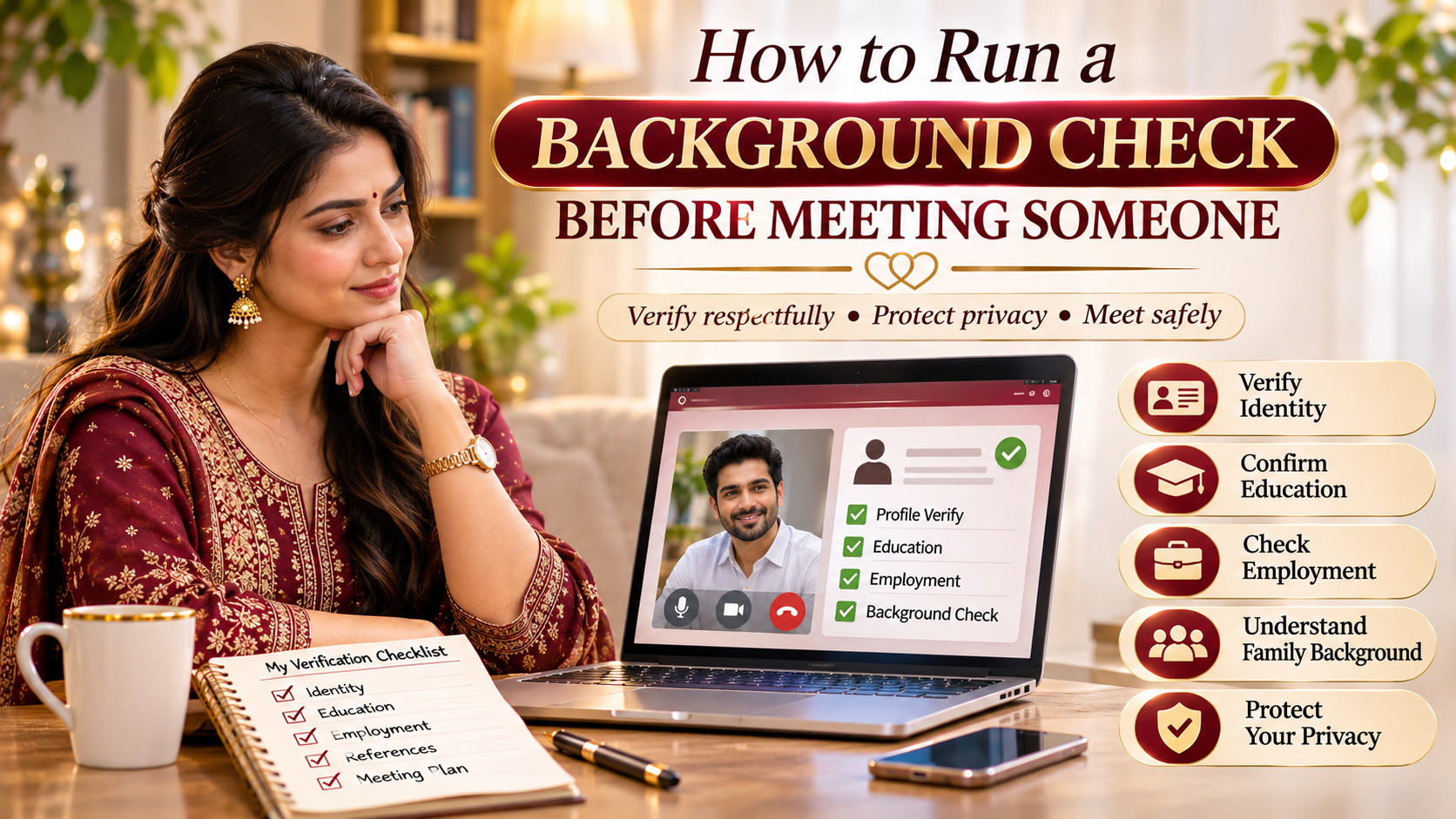
Why Background Verification Matters in Matrimonial Matchmaking
Meeting a prospective life partner can be exciting, particularly when conversations suggest shared values and compatible expectations. However, before arranging a personal meeting, it is sensible to verify important information.
Online matrimonial profiles may contain inaccurate details, misleading photographs, or fabricated identities. The FBI warns that romance scammers sometimes create convincing profiles to gain trust and exploit individuals financially.
A matrimonial background check should not involve spying, accessing private accounts, or collecting confidential information without permission. Instead, it should focus on reasonable, ethical verification.
The following steps can help individuals and families approach matrimonial meetings more confidently.
1. Start by Reviewing the Matrimonial Profile
Read the complete profile carefully before initiating further discussions.
Check whether the person's age, education, profession, location, and family background are clearly described.
Look for contradictions between the written profile and information shared during conversations.
For example, unexplained differences in employment history or residential location may require clarification.
Minor inconsistencies do not automatically indicate dishonesty. Give the person an opportunity to explain.
2. Verify Photographs Through Reverse Image Search
Photographs are useful for recognition, but they do not independently establish identity.
Use Google Lens or another reputable reverse image search tool to check whether profile photographs appear elsewhere online.
If the same photograph appears under unrelated names, investigate carefully.
The US Federal Trade Commission recommends reverse image searches as one practical method for recognising possible romance scams.
Remember that no matching search results do not guarantee authenticity.
3. Confirm Educational Qualifications
Education often influences matrimonial compatibility and future expectations.
Ask about the person's institution, degree, specialisation, and graduation period.
Where appropriate, verify information through official institutional records or documents shared voluntarily.
Avoid contacting educational institutions through deceptive methods or demanding unnecessary personal records.
The objective is to confirm important claims respectfully.
4. Check Employment and Professional Background
Professional information can sometimes be verified through company websites, official professional registers, or publicly available career profiles.
Ask about the person's job responsibilities, industry, and general career plans.
For regulated professions, relevant registration authorities may provide public verification facilities.
Be cautious about exaggerated employment claims or repeated inconsistencies.
However, remember that many genuine professionals maintain limited online visibility.
5. Clarify Marital Status and Previous Relationships
Marital status is an important consideration before serious matrimonial commitments.
Discuss whether the person is never married, divorced, widowed, or legally separated.
If a previous marriage is relevant, seek clarity about its legal status.
Any documentary verification should be lawful, proportionate, and handled respectfully.
A person's previous marriage should not be treated as a negative characteristic. Honesty about current legal eligibility is what matters.
6. Understand Family Background and Expectations
Family participation remains significant in many Indian matrimonial decisions.
Ask about family structure, general values, living arrangements, and expectations after marriage.
When both individuals are comfortable, a family introduction may provide additional context.
However, family participation is not a substitute for individual consent or compatibility.
Avoid intrusive inquiries into relatives' finances, personal disputes, or private circumstances.
7. Review Publicly Available Online Information
Public professional profiles and social media accounts may provide useful context.
Compare relevant information with the person's matrimonial introduction.
Look for consistency rather than expecting an extensive digital presence.
Some individuals deliberately limit social media activity for privacy reasons.
Never attempt to access private accounts, bypass security controls, track locations, or impersonate someone to obtain information.
8. Arrange a Respectful Video Conversation
A video call can help establish whether communication feels natural and whether the person resembles their profile photographs.
Discuss general interests, family values, career aspirations, and marriage expectations.
A genuine individual may prefer to build trust before agreeing to a video call, so respect reasonable boundaries.
Video calls provide additional reassurance but cannot conclusively verify identity, particularly when manipulated media is possible.
9. Identify Financial and Emotional Warning Signs
Be cautious when someone requests money, proposes investments, demands confidential documents, or pressures you into immediate commitment.
Scammers may invent medical emergencies, overseas travel difficulties, or urgent business expenses.
The FTC advises against sending money or gifts to an online romantic contact you have not met in person.
Do not share OTPs, passwords, banking credentials, or sensitive identification information.
10. Consider Professional Verification When Appropriate
For serious matrimonial discussions, some individuals choose professional background-verification services.
Before engaging an agency, confirm its credentials, methods, confidentiality practices, and applicable legal obligations.
Verification should be transparent, lawful, limited to relevant information, and based on appropriate consent.
India's Digital Personal Data Protection framework emphasises consent, transparency, purpose limitation, and responsible handling of personal information.
A professional report should not be mistaken for a guarantee of character or future behaviour.
11. Plan the First Meeting with Safety in Mind
Once reasonable checks are complete, arrange the first meeting in a public, accessible location.
Inform a trusted person about your plans and arrange independent transportation.
Avoid sharing your residential address or agreeing to an isolated meeting location.
If anything feels uncomfortable, you are free to postpone or end the meeting.
Personal safety should take priority over social expectations.
12. Know What to Do If You Suspect Fraud
If you discover serious inconsistencies, suspicious financial demands, or identity misuse, stop sharing information.
Preserve relevant messages, profile links, and transaction records.
Report the account through the matrimonial platform.
In India, suspected online matrimonial fraud can be reported through the National Cyber Crime Reporting Portal at cybercrime.gov.in. Financial cyberfraud can also be reported through helpline 1930.
Conclusion: Verification Builds Informed Trust
A responsible matrimonial background check is not about investigating every detail of someone's private life.
It is about confirming important facts, identifying genuine concerns, and protecting both individuals before making significant decisions.
Accurate information, respectful communication, appropriate consent, and sensible precautions can make matrimonial introductions safer.
The goal is not to find a person with a perfect history, but to build a relationship based on honesty, mutual respect, and informed trust.
Frequently asked questions
1. How can I verify someone's identity before a matrimonial meeting?
Review their profile for consistency, conduct a reverse image search, arrange a video conversation, and discuss relevant personal details. When necessary, use lawful, consent-based identity verification. No single method guarantees authenticity.
2. Is it legal to conduct a background check before marriage in India?
Background verification can be lawful when conducted through appropriate methods, with valid consent where required, and in compliance with applicable privacy and data protection laws. Unauthorised access to private accounts or confidential records should be avoided.
3. Can I verify someone's employment and education before marriage?
Yes. Public professional registers, official company information, and voluntarily shared educational documents may help confirm important claims. More detailed verification should use authorised, consent-based processes.
4. Should I hire a professional background verification agency?
Professional verification may be useful when significant claims require independent confirmation. Choose a reputable agency that explains its methods, obtains necessary consent, protects personal information, and complies with applicable laws.
5. What should I do if I discover false information in a matrimonial profile?
First, clarify possible misunderstandings. If serious deception or fraud is suspected, stop sharing sensitive information, preserve relevant evidence, and report the account to the matrimonial platform. Suspected cybercrime in India can be reported at cybercrime.gov.in.