Understanding Marriage Choices in Modern India
Marriage is one of life's most significant decisions, influencing emotional well-being, family relationships, personal aspirations, and long-term responsibilities.
In India, marriage traditions have evolved as education, professional opportunities, digital communication, and individual preferences increasingly influence partner selection.
While arranged marriages continue to play an important role, love marriages and love-cum-arranged marriages provide alternative approaches to finding a compatible life partner.
The central question is not which marriage type is universally better, but which approach aligns with your personality, values, expectations, and circumstances.
Understanding the differences can help you make a confident, informed decision.
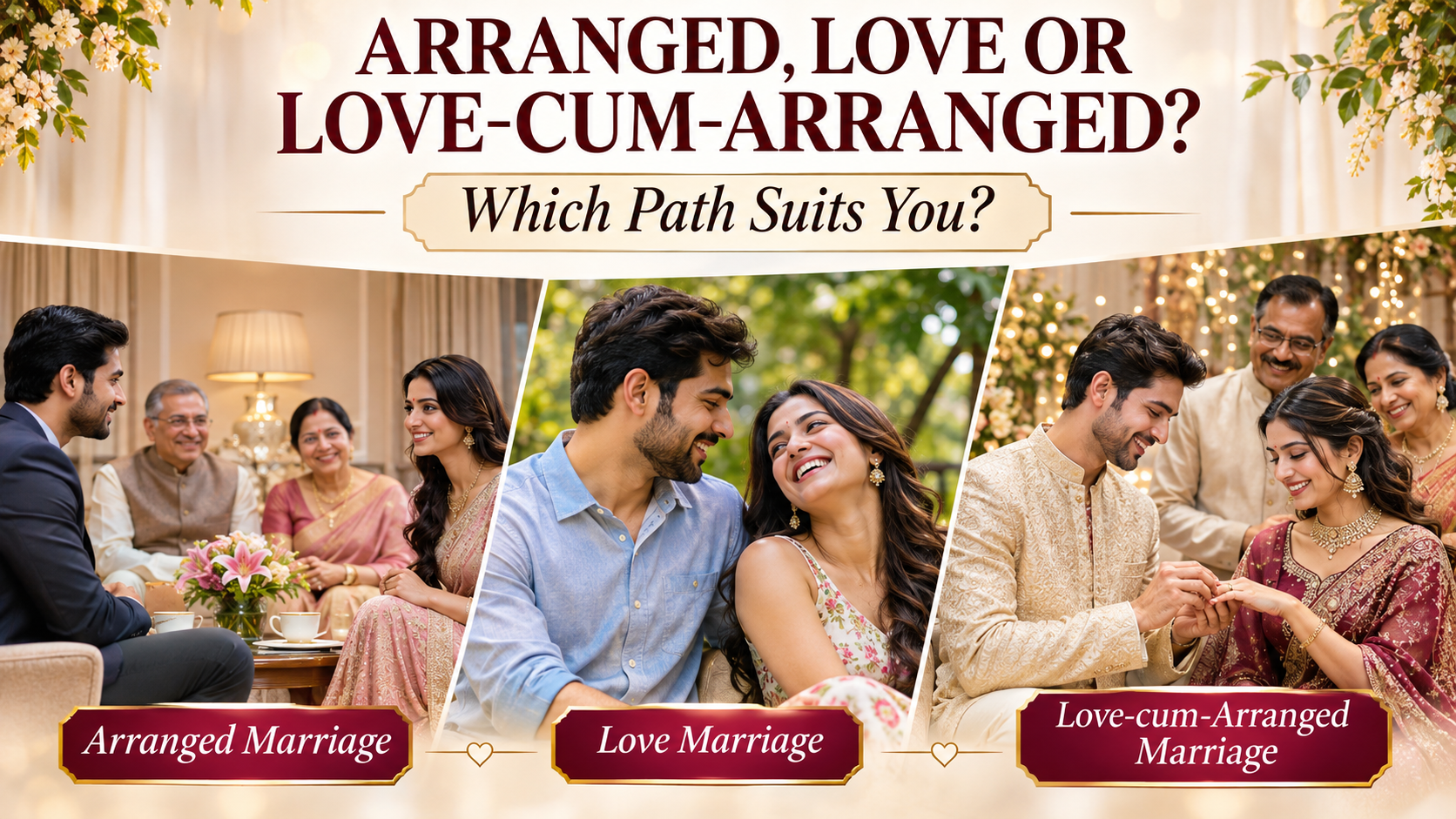
1. Arranged Marriage: Tradition Meets Modern Compatibility
Arranged marriage is a system in which families, relatives, or matrimonial networks introduce prospective partners based on factors such as education, profession, cultural background, lifestyle, and family values.
Modern arranged marriages increasingly involve personal conversations, meetings, and independent decisions before commitment.
Advantages of arranged marriage:
- Family guidance and participation throughout the matchmaking process.
- Introductions through established social or matrimonial networks.
- Opportunities to discuss cultural values and family expectations early.
- Practical support from relatives during marriage preparations.
Potential challenges:
Some individuals experience pressure to decide quickly or have limited opportunities to understand a prospective partner's personality.
Arranged marriage works best when both individuals receive adequate time, privacy, and complete freedom to make their own decisions.
2. Love Marriage: Choosing a Partner Through Personal Connection
Love marriage usually begins when two individuals develop a romantic relationship and subsequently decide to marry.
Because the relationship exists before marriage discussions, couples may already understand each other's personalities, emotional needs, communication habits, and preferences.
Advantages of love marriage:
- An established emotional connection before marriage.
- Personal involvement in choosing a life partner.
- Opportunities to understand individual habits and expectations.
- Experience handling disagreements and relationship challenges.
Potential challenges:
Romantic attachment does not automatically ensure agreement on finances, children, career goals, or family responsibilities.
Some couples may also face opposition from relatives or difficulties reconciling cultural expectations.
A successful love marriage requires practical compatibility alongside emotional affection.
3. Love-cum-Arranged Marriage: Combining Love and Family Support
Love-cum-arranged marriage combines personal partner selection with family participation.
Typically, two individuals develop a relationship, decide to marry, and subsequently involve their families in formalising their commitment.
This approach can preserve personal independence while welcoming family guidance and support.
Advantages of love-cum-arranged marriage:
- Personal choice combined with family involvement.
- Opportunities to develop emotional compatibility before marriage.
- Family participation in cultural traditions and wedding arrangements.
- Potential support from both families during married life.
Potential challenges:
Differences in family expectations, traditions, or social backgrounds can create disagreements.
Couples should communicate clearly, establish appropriate boundaries, and ensure family involvement does not override mutual consent.
4. Arranged vs Love vs Love-cum-Arranged: Key Differences
Although all three approaches aim to establish a committed partnership, they differ in how couples meet, develop relationships, and involve their families.
Partner Selection
In arranged marriages, families or matrimonial networks generally introduce prospective partners. In love marriages, individuals independently develop a relationship. Love-cum-arranged marriages typically begin with personal choice followed by family participation.
Family Involvement
Arranged marriages commonly involve families from the beginning. Love marriages may involve relatives later, while love-cum-arranged marriages deliberately combine the couple's choice with family support.
Emotional Understanding
In arranged marriages, emotional understanding may develop through meetings and conversations. Love marriages generally involve an established relationship, while love-cum-arranged marriages usually allow couples to develop their connection before formal family arrangements.
Decision-Making
All three approaches should respect individual autonomy. Regardless of family involvement, the final marriage decision must be voluntary and mutually agreed upon.
Compatibility Assessment
Every approach requires honest conversations about lifestyle, financial responsibilities, career ambitions, family expectations, children, and long-term goals.
5. What Does Research Say About Marriage Choices?
Research on marriage in India suggests that partner-selection practices are more varied than the traditional arranged-versus-love distinction implies.
Studies of Indian marriage practices describe arrangements in which families facilitate introductions while individuals retain varying degrees of choice.
Research also highlights the importance of personal autonomy, family expectations, and social circumstances in marriage decisions.
However, evidence does not establish that one marriage type consistently guarantees greater marital happiness.
Relationship quality depends on multiple factors, including communication, mutual respect, emotional support, safety, and the ability to manage disagreements constructively.
6. Five Important Questions Before Choosing Your Marriage Path
Before deciding which approach suits you, consider the following questions.
- How important is family involvement? Decide whether you prefer family-led introductions, independent partner selection, or a combination.
- How much time do you need to understand someone? Consider your preferred pace for developing trust and evaluating compatibility.
- What qualities matter most in a life partner? Identify essential values, emotional qualities, and long-term expectations.
- Can you make an independent decision? Marriage should never result from coercion, fear, or unwanted pressure.
- Are your future goals compatible? Discuss finances, career plans, living arrangements, children, and family responsibilities.
7. Mutual Consent Matters More Than Marriage Type
The foundation of any healthy marriage is mutual consent, respect, trust, and personal freedom.
Family guidance can be meaningful, but it should never replace an individual's right to choose a partner.
Couples should have sufficient opportunities to communicate honestly, evaluate compatibility, and address important concerns before marriage.
Whether a relationship begins through family introductions or personal affection, both individuals deserve dignity, independence, and emotional safety.
Conclusion: Choose the Marriage Path That Reflects Your Values
Arranged marriage provides structured introductions and family involvement. Love marriage emphasises an independently developed romantic connection. Love-cum-arranged marriage brings together elements of personal choice and family participation.
Each approach has potential advantages and challenges.
Rather than following social expectations blindly, choose the path that allows you to understand your partner, evaluate compatibility, and make a confident decision.
A successful marriage is not determined by how two people meet, but by the respect, understanding, commitment, and partnership they build together.
Frequently asked questions
1. Which is better: arranged marriage or love marriage?
Neither approach is universally better. Both can lead to fulfilling relationships when partners share compatible values, communicate honestly, respect each other's individuality, and make marriage decisions voluntarily.
2. What is the meaning of love-cum-arranged marriage?
Love-cum-arranged marriage generally refers to a relationship in which two individuals choose each other and subsequently involve their families in formalising the marriage. It combines personal partner selection with family participation.
3. Are arranged marriages still popular in India?
Yes. Arranged marriages remain an important part of Indian matrimonial traditions. However, modern arranged marriages increasingly include personal choice, direct communication, and compatibility assessment before commitment.
4. Can love marriage be successful without family approval?
Yes. Family approval can provide emotional and practical support, but it is not a requirement for a healthy marriage. Mutual consent, trust, compatibility, respect, and responsible decision-making are more fundamental.
5. How do I decide which type of marriage is right for me?
Consider your personality, family circumstances, emotional readiness, cultural values, and expectations from a life partner. Choose an approach that gives you sufficient time, independence, and confidence to make an informed decision.