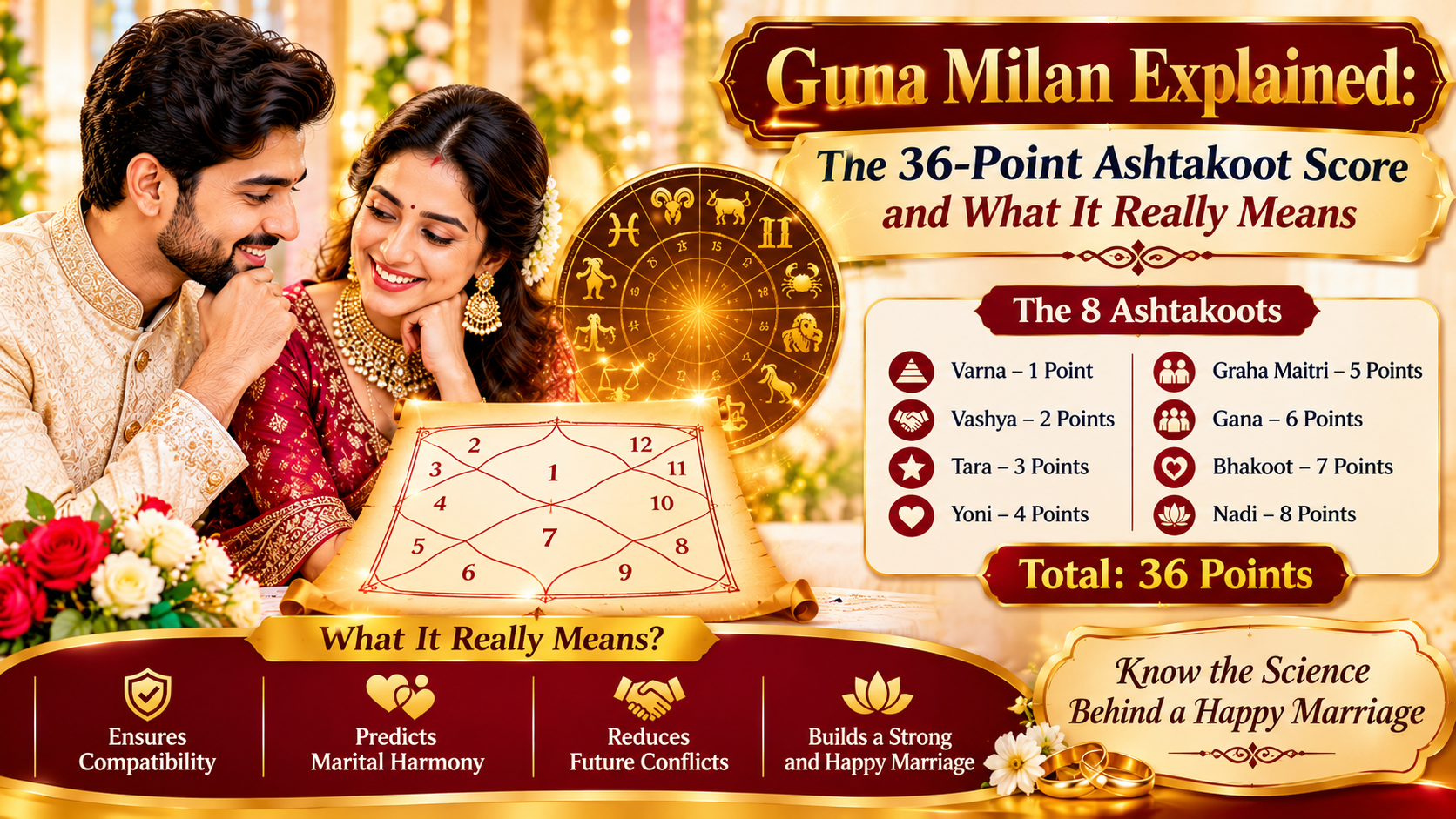
Kundli matching, also called horoscope matching or Guna Milan, is a traditional step in many Indian marriage searches. Families compare the birth charts of the boy and girl to judge compatibility. This guide explains the system in simple language so you can have an informed conversation with your astrologer. It is general information and not a substitute for personal astrological advice.
What is Ashtakoot Guna Milan?
The most common method in North India is Ashtakoot Milan, which compares eight factors, called kootas, based on the Moon's position at birth. Each koota carries points, and together they add up to 36.
The eight kootas and their points
| Koota | Points | What it represents |
|---|---|---|
| Varna | 1 | Temperament and ego compatibility |
| Vashya | 2 | Mutual attraction and influence |
| Tara | 3 | Health and well-being |
| Yoni | 4 | Physical and emotional compatibility |
| Graha Maitri | 5 | Mental compatibility and friendship |
| Gana | 6 | Nature and behaviour |
| Bhakoot | 7 | Emotional bond and family prosperity |
| Nadi | 8 | Health and genetic compatibility |
How to read the score
A score below 18 is usually seen as low, 18 to 24 as acceptable, 25 to 32 as good and above 32 as very good. These ranges are traditional guidelines, and astrologers differ in how strictly they apply them.
Manglik dosha
A person is called Manglik when Mars occupies certain houses in the birth chart. Traditionally, a Manglik is matched with another Manglik. Many astrologers also describe cancellation conditions based on the position of other planets or the age of the person. If your chart shows this dosha, ask your astrologer to explain the specific reasoning rather than relying on a generic online report.
Nadi dosha and Bhakoot dosha
Nadi dosha arises when both partners fall under the same Nadi and carries the highest weight of eight points. Bhakoot dosha relates to the Moon-sign relationship. Both are considered significant in tradition, and exceptions are also discussed in classical texts. A qualified astrologer can tell you whether any remedies or exceptions apply.
Steps to do kundli matching properly
- Collect accurate birth details: date, exact time and place.
- Generate both kundlis from a trusted software or astrologer.
- Compare the 36-point score and check the major doshas.
- Discuss the full charts, not only the number.
- Decide as a family, along with real-life compatibility checks.
Beyond the kundli: practical compatibility
Whatever role astrology plays for you, a successful marriage also depends on shared values, health, finances, career plans and the ability to communicate. Meet, talk openly and involve both families. Online platforms such as Matrimony Sites offer horoscope-related filters to help you shortlist profiles, but the final decision should balance tradition, practical factors and the comfort of both partners.
Tips to avoid confusion
- Do not rely on one free online tool alone.
- Check that the birth time is accurate, ideally from the birth certificate or hospital record.
- Be wary of anyone who creates fear and sells expensive remedies.
- Keep an open, respectful conversation within the family.
Frequently asked questions
What is the minimum Guna Milan score for marriage?
Many astrologers treat 18 out of 36 as the minimum acceptable score. Higher scores are considered better, but astrologers also look at the whole chart, not only the number.
Is Manglik dosha a reason to reject a match?
Traditions differ. Many astrologers believe the dosha is reduced or cancelled in certain chart conditions or when both partners are Manglik. Consult a trusted astrologer for your specific charts.
What details are needed for kundli matching?
Accurate date, exact time and place of birth for both people. Even small errors in birth time can change the chart.
Do all families rely on kundli matching?
No. Many families consider it important, others use it as one input among many, and some do not use it at all. Compatibility in values, health and communication matters for every couple.