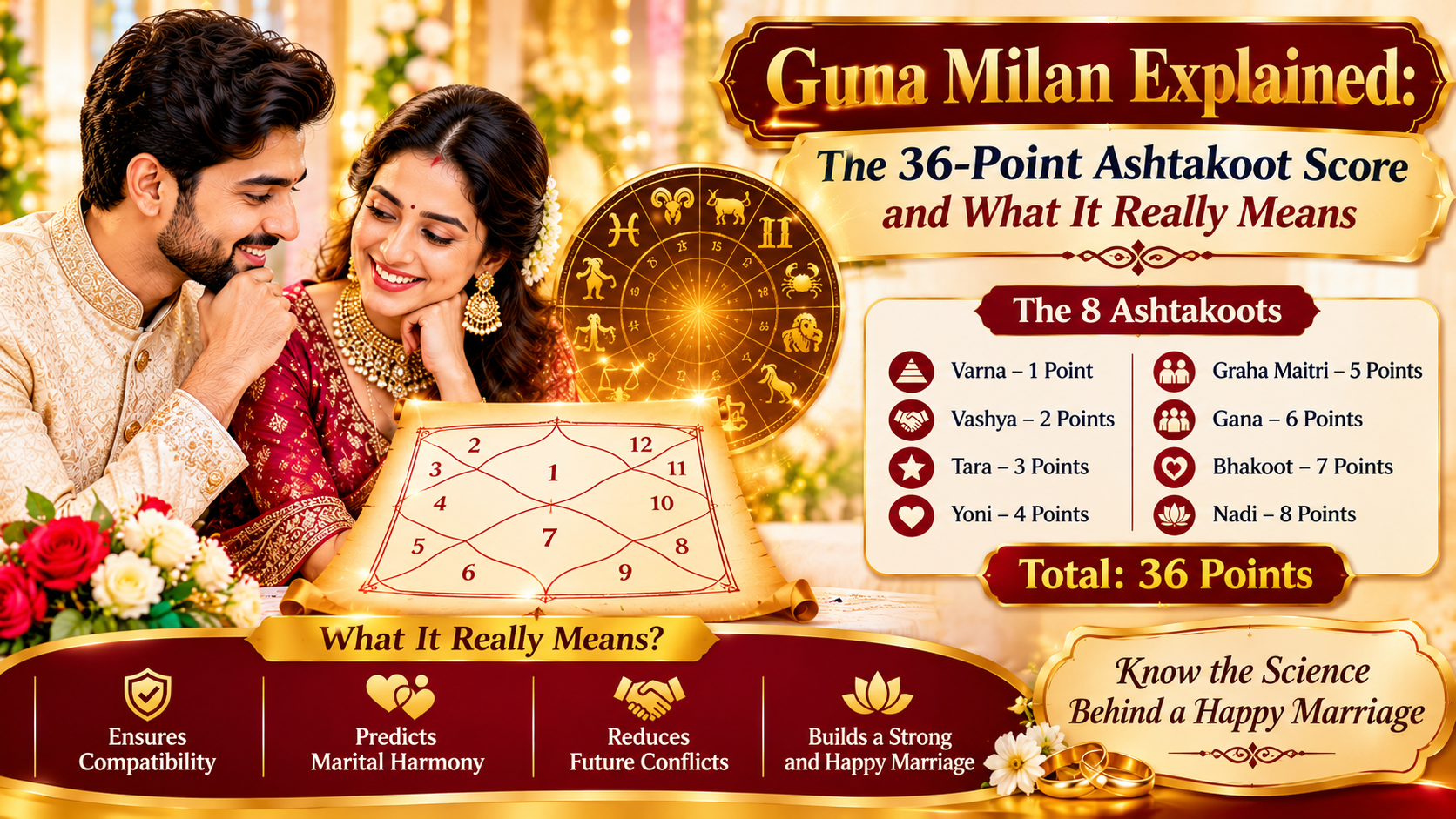
For many Indian families, kundli matching is a customary step before a marriage proposal moves ahead. The most widely used method is Ashtakoot Guna Milan, a system that compares the birth charts of two people and produces a score out of 36. The number is easy to quote but easy to misunderstand. This guide explains how it works and how to treat it sensibly.
What is Guna Milan?
Guna Milan is a traditional Vedic astrology method that compares the Moon sign and birth star, known as nakshatra, of the prospective bride and groom. It examines eight areas, called kootas, each carrying a fixed number of points. The total possible score is 36. Because the calculation depends on the position of the Moon at birth, an accurate birth date, time and place are essential.
The eight kootas and their points
- Varna (1 point): Traditionally linked to spiritual compatibility and ego
- Vashya (2 points): Associated with mutual attraction and influence between partners
- Tara (3 points): Linked to birth star compatibility and general well-being
- Yoni (4 points): Associated with physical and intimate compatibility
- Graha Maitri (5 points): Considered a measure of mental and intellectual compatibility
- Gana (6 points): Relates to temperament, categorised as Deva, Manushya and Rakshasa
- Bhakoot (7 points): Associated with emotional bond, family welfare and prosperity
- Nadi (8 points): Linked traditionally to health and the well-being of future children
Adding these gives the total of 36.
How to read the score
Many astrologers treat 18 points as the minimum acceptable level. A common way of describing scores is that below 18 indicates low compatibility, 18 to 24 is average to good, 25 to 32 is very good, and above 32 is considered excellent. These bands are a convention, not a rule, and practitioners may interpret them differently.
Understanding Nadi and Bhakoot doshas
Two doshas often cause worry. Nadi dosha occurs when partners share the same Nadi, which leads to a zero score in that koota and a loss of 8 points. Bhakoot dosha arises from certain Moon sign combinations and costs 7 points. Traditional texts describe exceptions and cancellations, for example when the Moon signs share the same ruling planet or when other factors in the chart balance the issue. A qualified astrologer can examine whether such exceptions apply, so a dosha does not automatically mean rejection.
Guna Milan versus Manglik matching
Manglik dosha is assessed separately from the 36-point score. It relates to the position of Mars in the birth chart. Families often check both. A good Guna Milan score does not automatically settle Manglik concerns, and traditional remedies or matching between two Manglik individuals are discussed by astrologers. Treat each factor on its own terms.
Why the same couple can get different results
Different astrologers and software may calculate slightly differently, especially if the birth time is approximate or a different ayanamsa is used. Regional traditions such as North and South Indian systems also vary in emphasis. If you receive a worrying result, consider a second opinion before drawing conclusions.
Limitations to keep in mind
Guna Milan looks at two charts, but it cannot assess how two people communicate, handle money, treat each other's families or respond to stress. These factors shape a marriage far more than any score. Scientific evidence does not support astrological predictions of marital success, and many families therefore use kundli matching as one input among several instead of the deciding factor.
A balanced approach
If kundli matters to your family, check it early so that you do not become emotionally invested in a match that your elders will not accept. At the same time, assess practical compatibility through honest conversations about values, careers, family expectations and lifestyle. Consult a qualified, ethical astrologer and be cautious of anyone who creates fear and then sells expensive remedies.
Final thoughts
Guna Milan is a cultural and religious tradition that gives many families comfort and shared language. Understand how the score works, seek a reliable professional opinion and keep it in perspective. A marriage is built on trust, respect and effort, which no score can measure.
This article is general information and not astrological advice. Please consult a qualified astrologer for personal guidance.
Frequently asked questions
1. What is the minimum Guna Milan score needed for marriage?
Many astrologers consider 18 out of 36 as the minimum acceptable score. Some families insist on higher scores, while others treat it as one factor among many.
2. Can a marriage go ahead with Nadi dosha?
Traditional texts mention exceptions and remedies in some situations. A qualified astrologer should assess your charts before any decision is made.
3. Is a score of 36 out of 36 a guarantee of a happy marriage?
No. A high score reflects astrological compatibility only. Daily communication, respect and shared values determine marital happiness.
4. What details are needed for kundli matching?
You need an accurate date, exact time and place of birth for both individuals. Even small errors in birth time can change results.
5. Is Manglik dosha included in the 36 points?
No. Manglik dosha is assessed separately and is considered alongside the Guna Milan score.