Finding a suitable life partner is an important decision for individuals and families across India. With diverse religious beliefs, cultural traditions, languages and social communities, matrimonial preferences often vary from one family to another.
Modern matrimonial websites provide advanced search filters that allow individuals to explore potential marriage partners based on community, sub-community, Gotra, education, profession, location and lifestyle preferences.
Understanding how to use these filters effectively can make your matrimonial search more organised, relevant and convenient while respecting individual choices and cultural traditions.
Understanding Community, Sub-Community and Gotra
Before starting your matrimonial search, it is important to understand the differences between these three commonly used terms.
What Is a Community?
A community refers to a social or cultural group that may share traditions, customs, religious beliefs or historical backgrounds.
In India, commonly searched matrimonial communities include Brahmin, Rajput, Agarwal, Kayastha, Jat, Khatri, Jain and several regional and religious groups.
Community search filters help individuals identify profiles that align with their preferred cultural background.
What Is a Sub-Community?
A sub-community is a smaller group within a broader community. It may be associated with regional traditions, historical origins, family customs or social practices.
For example, some Brahmin communities include Gaur, Kanyakubja, Saraswat and Maithil Brahmins.
Sub-community filters allow individuals to conduct more specific matrimonial searches according to their personal and family preferences.
What Is Gotra?
Gotra is a traditional lineage classification followed by certain Hindu communities. It is commonly associated with ancestral lineages and family heritage.
Some families traditionally prefer marriage between individuals belonging to different Gotras. However, Gotra-related customs vary considerably across communities and regions.
Not every community follows the Gotra system, and individuals should avoid treating it as a universal marriage requirement.
How to Search Matrimonial Profiles by Community
Step 1: Create a Complete Matrimonial Profile
Begin by registering on a matrimonial website and providing accurate information about your education, profession, location, interests and marriage expectations.
Include community, sub-community and Gotra details only when relevant and when you are comfortable sharing them.
A complete and honest profile can help other marriage-minded individuals understand your background and preferences.
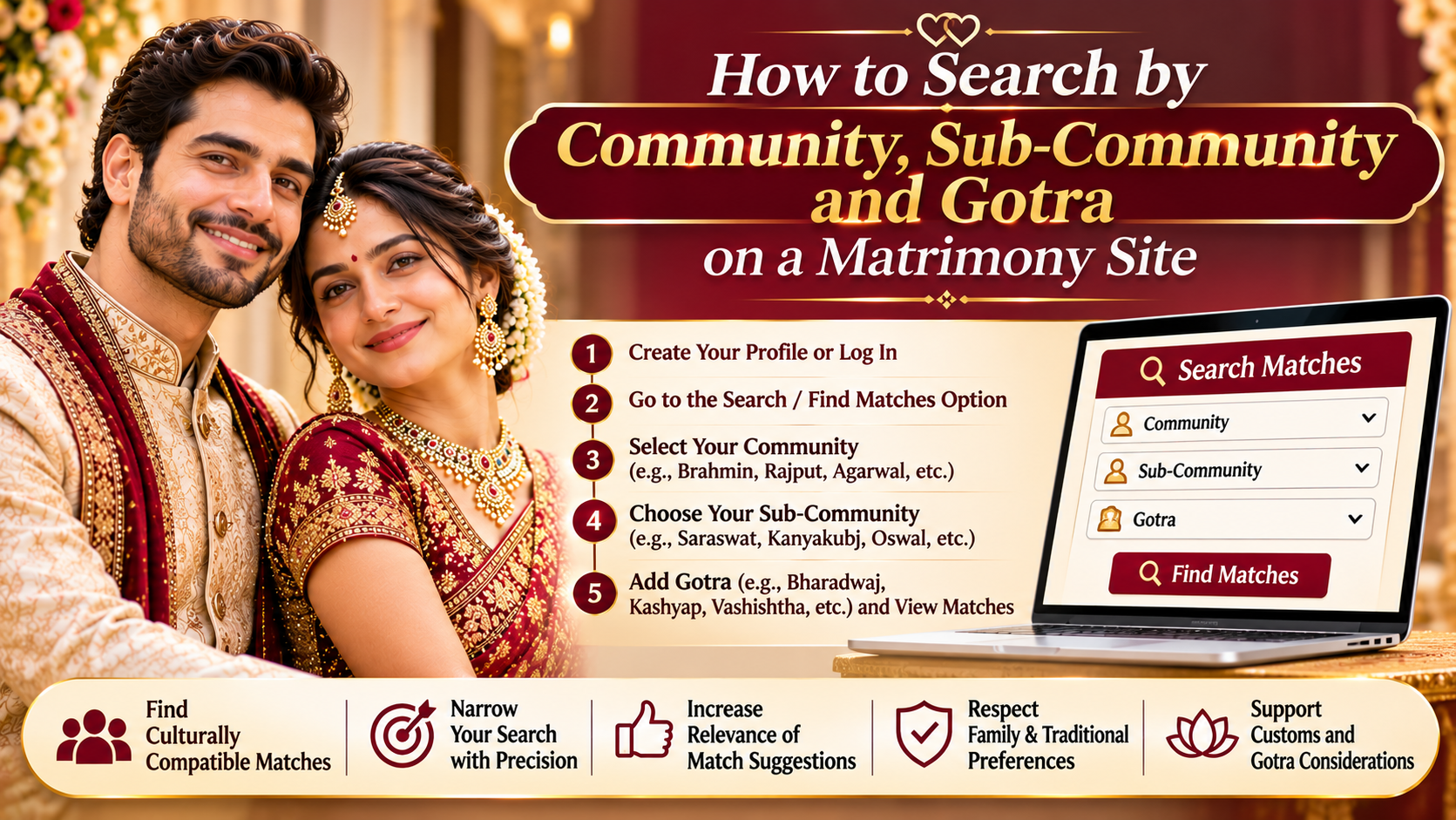
Step 2: Open the Advanced Search Section
Most matrimonial websites provide basic or advanced search options. Navigate to the partner search section and explore the available filters.
Depending on the platform, these may include religion, community, sub-community, mother tongue, age, education, profession, marital status and location.
Step 3: Select Your Preferred Community
Choose the community that matches your matrimonial preferences. Some websites allow users to select multiple communities or keep their preferences open.
Selecting multiple relevant communities can help expand your search without unnecessarily restricting potential opportunities.
Step 4: Apply Sub-Community Filters
If sub-community preferences are important to you, select the relevant options from the available categories.
Remember that different matrimonial websites may use different spellings, classifications and regional names. Try alternative search terms if your preferred sub-community is unavailable.
Step 5: Search by Gotra
Some matrimonial websites provide a dedicated Gotra search filter, while others include Gotra information within individual profiles.
If a dedicated filter is unavailable, review the profile's family information or respectfully discuss the details during initial conversations.
Always confirm Gotra information directly rather than relying entirely on online profile entries.
Why Gotra Matching Is Important to Some Indian Families
Gotra matching holds traditional significance for certain Hindu families. Depending on their customs, families may consider ancestral lineage when evaluating matrimonial proposals.
However, sharing the same Gotra does not necessarily establish a close biological relationship, and different Gotras do not guarantee genetic compatibility.
Gotra preferences should not replace applicable marriage laws, informed personal decisions or professional medical advice when hereditary health concerns exist.
Combine Community Filters With Personal Compatibility
Community, sub-community and Gotra filters are useful for identifying profiles that match cultural preferences. However, a successful marriage requires more than shared traditions.
Individuals should also consider educational compatibility, career aspirations, emotional maturity, communication skills, financial expectations, lifestyle preferences and long-term relationship goals.
Discuss important subjects such as family responsibilities, relocation, personal independence and future plans before making a commitment.
Common Mistakes to Avoid During Matrimonial Searches
Applying too many restrictive filters can significantly reduce the number of potential matches. Avoid rejecting suitable individuals solely because of minor differences in cultural background or lifestyle.
Never assume that community membership guarantees honesty, compatibility or shared personal values.
Verify important profile details independently, protect sensitive personal information and avoid sending money to unfamiliar individuals.
Family involvement can provide valuable guidance, but both individuals should freely consent to any marriage decision.
Benefits of Advanced Matrimonial Search Filters
Advanced search filters can help individuals save time, organise matrimonial preferences and discover more relevant profiles.
They may also help NRIs and individuals living away from their hometowns connect with people who share familiar cultural traditions.
Personalised matchmaking services can offer additional assistance when individuals have specific community preferences or require support with profile selection and introductions.
Conclusion
Searching by community, sub-community and Gotra on a matrimony site can help individuals explore marriage opportunities according to their cultural traditions and personal preferences.
By using advanced search filters, maintaining accurate profiles and remaining flexible about non-essential requirements, individuals can make their matrimonial search more effective.
Ultimately, the foundation of a successful marriage is mutual respect, trust, emotional compatibility, honest communication and shared aspirations. Cultural preferences can guide the search, but personal understanding and mutual consent should remain central to every matrimonial decision.
Frequently asked questions
1. How can I search for matrimonial profiles by community?
Open the advanced search section of a matrimonial website, select your preferred community and apply additional filters such as age, education, profession, location and mother tongue to discover relevant profiles.
2. What is the difference between community, sub-community and Gotra?
A community is a broader social or cultural group, a sub-community is a smaller group within that community, and Gotra is a traditional ancestral lineage classification followed by certain Hindu communities.
3. Can I search matrimonial profiles by Gotra online?
Yes. Some matrimonial websites offer dedicated Gotra search filters. If this feature is unavailable, you can review individual profile details or respectfully confirm Gotra information during conversations.
4. Is Gotra matching compulsory for marriage in India?
No. Gotra matching is not a universal legal requirement for marriage in India. Its traditional significance varies across communities, regions and family customs. Applicable marriage laws and mutual consent should be respected.
5. Can I select multiple communities on a matrimonial website?
Many matrimonial websites allow users to select multiple communities or keep their community preferences open. This can help expand the partner search and provide more opportunities to find compatible individuals.