The Right Venue Is More Than a Beautiful Location
Choosing a wedding venue is one of the most important decisions in wedding planning. Whether you prefer a luxury hotel, banquet hall, garden, heritage property, or destination resort, the venue influences your budget, guest experience, ceremony arrangements, and overall celebration.
Beautiful photographs and attractive packages can create a strong first impression. However, practical details such as capacity, accessibility, safety, service quality, and contractual obligations deserve equal attention.
Wedding planning guidance consistently recommends comparing complete costs, checking actual usable capacity, and obtaining written confirmation before paying a deposit.
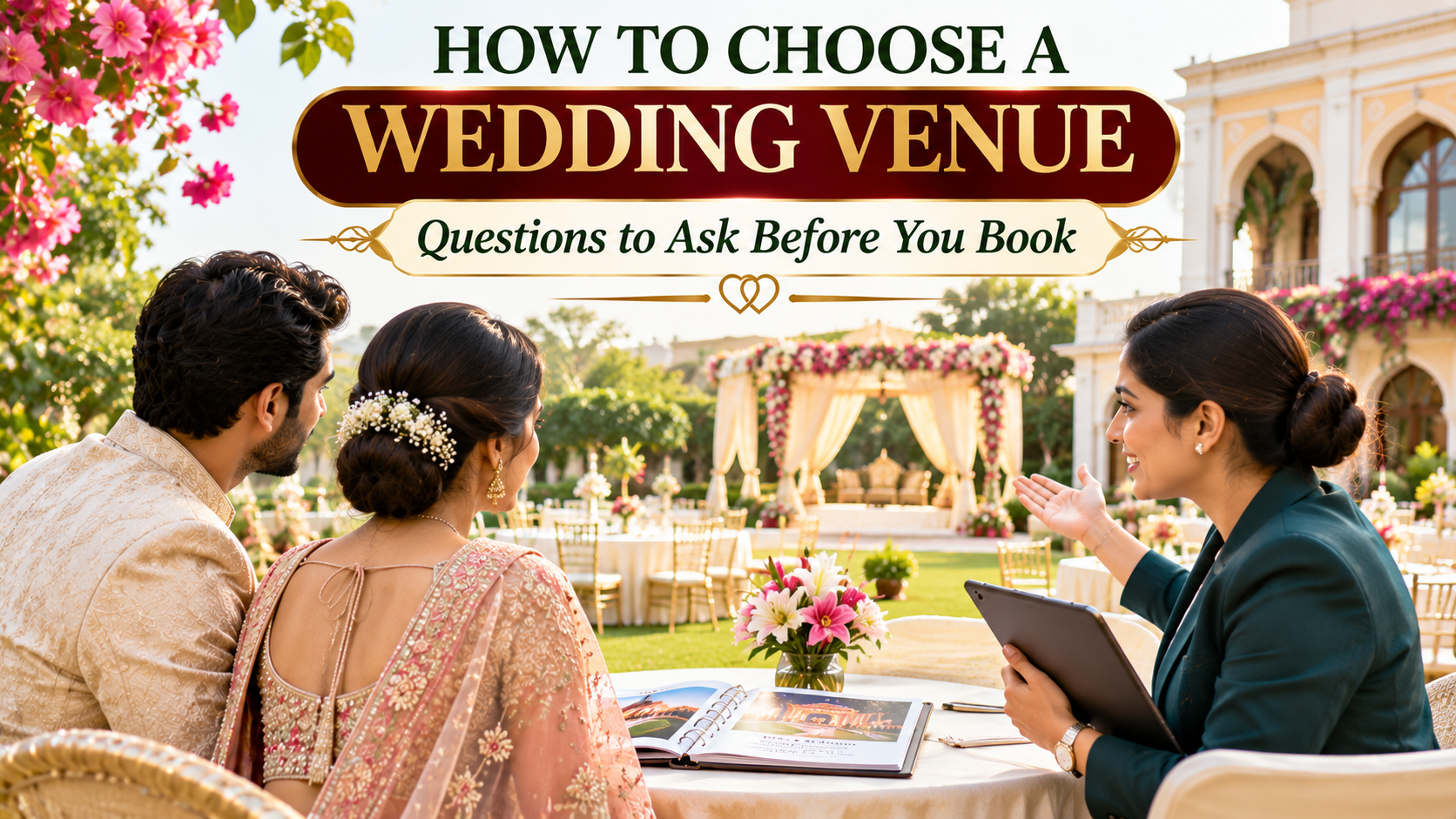
Here are twelve essential questions to ask before booking your wedding venue.
1. Is the Venue Available on Our Preferred Wedding Date?
Start by confirming availability for your chosen wedding date and ceremony timings.
If your family follows a traditional wedding Muhurat, check whether the venue can accommodate the required rituals.
Ask whether other weddings or events will take place on the same day.
Also confirm whether the booking provides exclusive access to the property or only certain areas.
Important question: What spaces and hours are reserved exclusively for our celebration?
2. What Is the Actual Guest Capacity?
A venue's advertised capacity may differ from the number of guests it can comfortably accommodate.
A banquet hall that appears spacious when empty may become crowded after adding a stage, mandap, buffet counters, and seating arrangements.
Ask for capacity based on your proposed layout.
Consider adequate walking space, emergency exits, dining arrangements, and accessibility for elderly guests.
Never exceed the venue's authorised occupancy limit.
3. What Is Included in the Wedding Package?
Wedding packages differ significantly between venues.
Some include catering, furniture, lighting, decoration, and basic coordination. Others charge separately for these services.
Ask for a detailed written list of inclusions.
Clarify whether the package covers bridal rooms, housekeeping, security, electricity, air conditioning, and setup assistance.
Important question: Which services will require additional payment?
4. Are There Hidden Charges or Additional Taxes?
The initial quotation may not represent the final wedding expense.
Potential additional charges include applicable taxes, service fees, overtime, extra guests, decoration upgrades, parking, cleaning, and generator usage.
Request an itemised, tax-inclusive estimate based on your expected guest count.
Compare quotations using the same services and requirements rather than focusing only on the advertised per-plate price.
Transparent pricing helps prevent unexpected financial pressure.
5. What Catering Options Are Available?
Food quality is a major consideration for Indian weddings.
Ask whether the venue provides in-house catering or permits external caterers.
Discuss vegetarian, Jain, vegan, allergy-related, and other dietary requirements.
Confirm menu customisation, tasting sessions, food-service timings, and minimum guest guarantees.
Also ask how the venue manages food hygiene, preparation, storage, and service during large gatherings.
6. Can We Choose Our Own Decorators and Vendors?
Some venues require clients to use approved decorators, caterers, or technical service providers.
Others allow external vendors but impose additional charges.
Before booking, clarify the rules regarding photographers, decorators, entertainment providers, and wedding planners.
Ask whether traditional arrangements such as a havan, mandap, or baraat require specific permissions.
Vendor flexibility can significantly influence the final budget and wedding experience.
7. Is the Location Convenient for Guests?
Consider how easily guests can reach the venue.
Check road connectivity, parking capacity, public transportation, and accommodation options.
If relatives are travelling from another city or country, evaluate proximity to airports, railway stations, and hotels.
Ensure entrances, toilets, and event spaces are accessible to guests with mobility needs.
Guest convenience should remain an important part of venue selection.
8. What Happens If the Weather Changes?
Outdoor weddings require dependable backup arrangements.
Rain, extreme heat, strong winds, or cold weather can disrupt ceremonies and affect guest comfort.
Ask whether the venue provides an indoor alternative, covered spaces, cooling systems, or heating arrangements.
Confirm whether the backup space can accommodate your full guest count.
The alternative should be genuinely available for your event, not merely mentioned during the venue tour.
9. What Safety and Emergency Facilities Are Available?
Wedding venues should have appropriate safety arrangements for their size and activities.
Ask about applicable fire-safety approvals, emergency exits, evacuation procedures, first-aid arrangements, and backup power.
Check whether emergency routes remain unobstructed after decoration and seating installations.
For large gatherings, discuss crowd management and security responsibilities.
Request relevant safety documentation rather than relying entirely on verbal assurances.
10. What Are the Venue's Timing Restrictions?
Confirm when decorators and caterers can enter, when guests may arrive, and when celebrations must end.
Ask about music restrictions, sound limits, and overtime charges.
Traditional ceremonies sometimes continue late into the night, so timing flexibility may be important.
Ensure that your planned schedule complies with applicable local regulations.
11. What Is the Cancellation and Refund Policy?
Unexpected circumstances may require postponement, cancellation, or changes to the guest count.
Before paying, review the deposit conditions, payment schedule, refund provisions, and rescheduling options.
Ask what happens if the venue cancels, becomes unavailable, or cannot deliver the agreed services.
Every important condition should appear in the written agreement.
12. Have We Personally Inspected the Venue?
Never rely entirely on promotional photographs.
Visit the property, preferably around the same time of day as your planned celebration.
Inspect washrooms, parking, dining areas, guest rooms, accessibility, cleanliness, and staff responsiveness.
Request a walkthrough of the proposed event layout.
A personal inspection can reveal practical concerns that are difficult to identify online.
Conclusion: Book with Confidence, Not Just Excitement
The ideal wedding venue should balance appearance, affordability, comfort, safety, and reliable service.
Before making a payment, compare multiple options, review complete quotations, inspect facilities, and obtain written confirmation of important arrangements.
Avoid rushing because of promotional offers or claims of limited availability.
A beautiful venue creates the setting for your wedding, but thoughtful planning creates a celebration that everyone can enjoy.
Frequently asked questions
1. What should I check before booking a wedding venue?
Check date availability, actual guest capacity, complete pricing, catering options, parking, accessibility, safety arrangements, vendor restrictions, and cancellation terms. Inspect the property personally and obtain written confirmation before paying a deposit.
2. How far in advance should I book a wedding venue?
For popular wedding dates and high-demand venues, starting your search 9–12 months in advance can be helpful. However, booking timelines depend on location, season, guest count, and venue availability.
3. How can I avoid hidden wedding venue charges?
Request an itemised, tax-inclusive quotation covering catering, decoration, furniture, electricity, cleaning, overtime, parking, and additional guests. Confirm all mandatory charges and exclusions in the written agreement.
4. Is it necessary to visit a wedding venue before booking?
A personal visit is strongly recommended. It helps you assess cleanliness, actual capacity, accessibility, parking, facilities, and service quality. If an in-person visit is impossible, request a live virtual walkthrough and independent verification.
5. What should I do before paying a wedding venue booking advance?
Review the contract, verify the venue's identity and payment details, confirm the reserved date and spaces, and understand refund and postponement policies. Obtain an official receipt for every payment.